Evaluate if possible the following limits, Check if L'Hopital's rule is appropriate to use, if so use it.
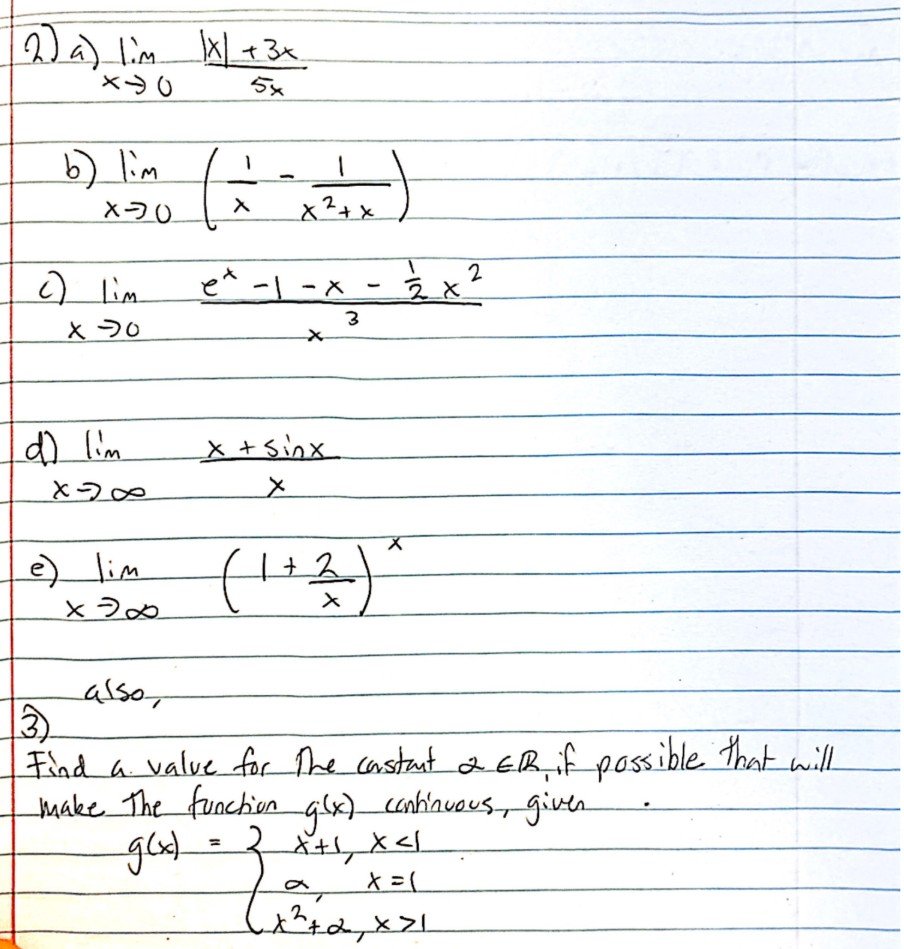
Answer
Answers can only be viewed under the following conditions:
- The questioner was satisfied with and accepted the answer, or
- The answer was evaluated as being 100% correct by the judge.
 Kav10
Kav10
2.1K
-
Hi, so sorry but I don't know what the taylor expansion is, is there any way you could do that problem without using it?
-
Hi. Yes, it can, but will probably get more complicated because it will need two times use of L'Hopitals rule. I will update the solution for you now.
-
See updated solution. Used L'Hopitals rule 3 times.
-
-
For your next questions, you can send me a direct question. Just click on my profile and then click on "Ask Direct Question".
The answer is accepted.
Join Matchmaticians Affiliate Marketing
Program to earn up to a 50% commission on every question that your affiliated users ask or answer.
- answered
- 1895 views
- $100.00
Related Questions
- Inclusion-Exclusion and Generating Function with Coefficient (and Integer Equation)
- Find $lim_{x \rightarrow 0^+} x^{\ln x}$
- continuous function
- Amendment to "Same exponents in two nonlinear function deriving the same result?"
- Growth of Functions
- Calculus - functions, method of Least Squares
- Does $\lim_{n \rightarrow \infty} \frac{2^{n^2}}{n!}$ exist?
- Compounding interest of principal P, where a compounding withdrawal amount W get withdrawn from P before each compounding of P.