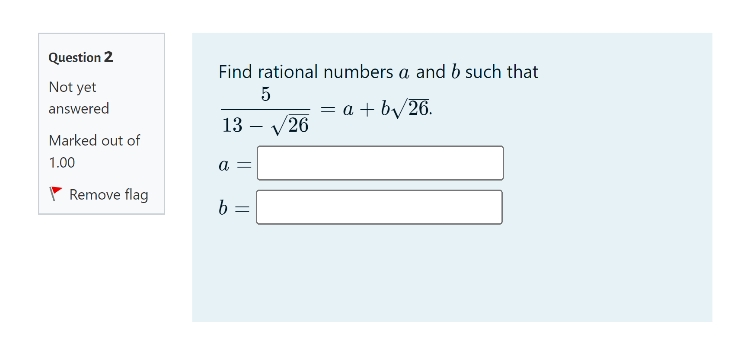
Find rational numbers A & B given the attached formula
Please check the image posted. I don't think this is all that complicated, but I've not studied maths for like 10 years & I'm currently on a refresher course, I keep going around in circles with this example question and would like to see the workings as i assume I'm missing something obvious. My approach was to multiply by 1, find the value of a in terms of b, substitute that into the equation and then solve for b...
But in my answer box I'm not allowed variables so although I get to:
a=((5*13+sqrt(26)))/143)-b*sqrt(26)
That is not a valid answer because it can't contain b, but if I substitute that in place of a into the original formula and try to find b it all cancels each other out and I'm left with 0. So unless it's a trick and the answer is zero, I'm pretty lost.
Apologies for the horrendous text formula, this is just how I have to enter it on the site.
But in my answer box I'm not allowed variables so although I get to:
a=((5*13+sqrt(26)))/143)-b*sqrt(26)
That is not a valid answer because it can't contain b, but if I substitute that in place of a into the original formula and try to find b it all cancels each other out and I'm left with 0. So unless it's a trick and the answer is zero, I'm pretty lost.
Apologies for the horrendous text formula, this is just how I have to enter it on the site.
 Jscales
7
Answer
Answers can only be viewed under the following conditions:
- The questioner was satisfied with and accepted the answer, or
- The answer was evaluated as being 100% correct by the judge.
 Alessandro Iraci
1.7K
-
Gah that was so simple, I'd not clicked that the fraction I had was already in the format of the other side of the equation (after the multiplication by 1). Every time I'm tripping up it's the simple things! Cheers for your time.
The answer is accepted.
Join Matchmaticians Affiliate Marketing
Program to earn up to a 50% commission on every question that your affiliated users ask or answer.
- answered
- 1334 views
- $4.92
Related Questions
- Mathematical Model: Discrete Logistic Growth and Fish Harvesting
- Mechanical principle science (maths)
- Find an expression for the total area of the figure expressed by x.
- Does $\lim_{(x,y)\rightarrow (0,0)}\frac{(x^2-y^2) \cos (x+y)}{x^2+y^2}$ exists?
- Representation theory quick question
- Fluid Mechanics - algebra
- Element satisfying cubic equation in degree $5$ extension
- Let $z = f(x − y)$. Show that $\frac{\partial z}{\partial x}+\frac{\partial z}{\partial y}=0$