Convex subset
Let $A$ be the subset of $\mathbb{R}^2$ given by
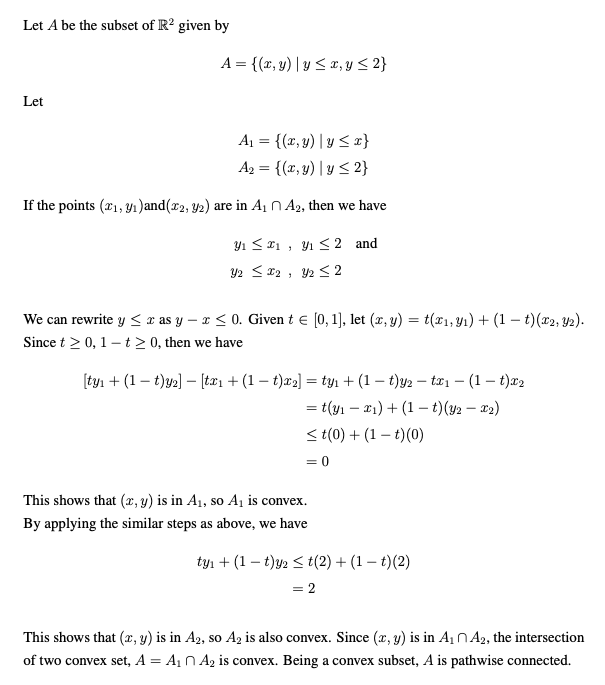
$A = \{(x,y) \hspace{1mm} | \hspace{1mm} y\leq x, y\leq 2\}$. Show that A is convex.
Please help me check the steps below which shows that A is indeed convex by using the fact that the intersection of two convex subsets is convex.
$A = \{(x,y) \hspace{1mm} | \hspace{1mm} y\leq x, y\leq 2\}$. Show that A is convex.
Please help me check the steps below which shows that A is indeed convex by using the fact that the intersection of two convex subsets is convex.
 Imanonymous
68
Answer
Answers can only be viewed under the following conditions:
- The questioner was satisfied with and accepted the answer, or
- The answer was evaluated as being 100% correct by the judge.
 Erdos
Erdos
4.8K
-
Just to confirm, since A is convex, then A is indeed pathwise connected right?
-
May I know how we can get tx_1+(t-1)x_2<=ty_1+(1-t)y_2?
-
You indeed have the inequality in the opposite order and just revised my solution. That because y_1 <=x_1 and y_2 <= x_2.
-
Is it still correct if I rewrite it as y_1-x_1<=0? Just like what I wrote in my proof.
-
Yes, but I prefer the way I have written is as it is closer to the definition of A_1.
-
Alright. Thank you for your help :)
-
Yes.

The answer is accepted.
Join Matchmaticians Affiliate Marketing
Program to earn up to a 50% commission on every question that your affiliated users ask or answer.
- answered
- 1760 views
- $3.50
Related Questions
- Finding the arc length of a path between two points
- Scalar fields, potentia
- Compute the curl of $F=(x^2-\sin (xy), z-cox(y), e^{xy} )$
- Evaluate the line intergral $\int_C (2x^3-y^3)dx+(x^3+y^3)dy$, and verify the Green's theorem
- Applications of Stokes' Theorem
- Evaluate the surface integral $\iint_{S}F \cdot dn$ over the given surface $S$
- Banach's fixed point theorem application
- Evaluate $\int \ln(\sqrt{x+1}+\sqrt{x}) dx$