Sequence and Series
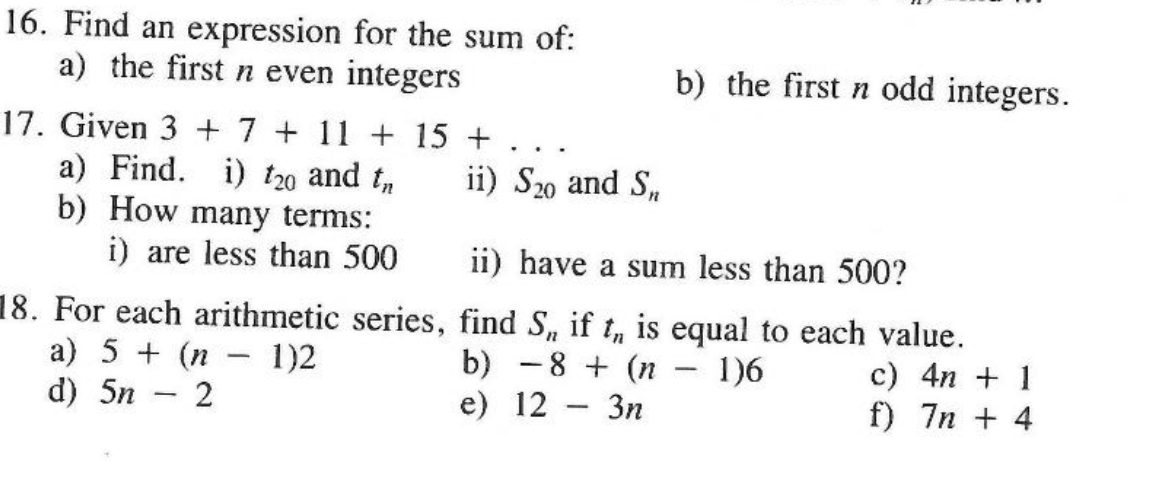
Please Provide full instructions and be clear and don't skip any steps

Answer
Answers can only be viewed under the following conditions:
- The questioner was satisfied with and accepted the answer, or
- The answer was evaluated as being 100% correct by the judge.
1 Attachment
 Jbarth
160
-
hey man the answers are 16 a and b are wrong a is n(n+1) and b is N^2
-
Hi, they are both correct. For a, 0 is the first even integer. If the problem had said first n even positive integers, then what you put would be correct. For b, what I put is the same as what you said, since n + n(n-1)= n^2 + n-n= n^2

The answer is accepted.
Join Matchmaticians Affiliate Marketing
Program to earn up to a 50% commission on every question that your affiliated users ask or answer.
- answered
- 1654 views
- $8.00