Applications of Integration [Calculus 1 and 2]
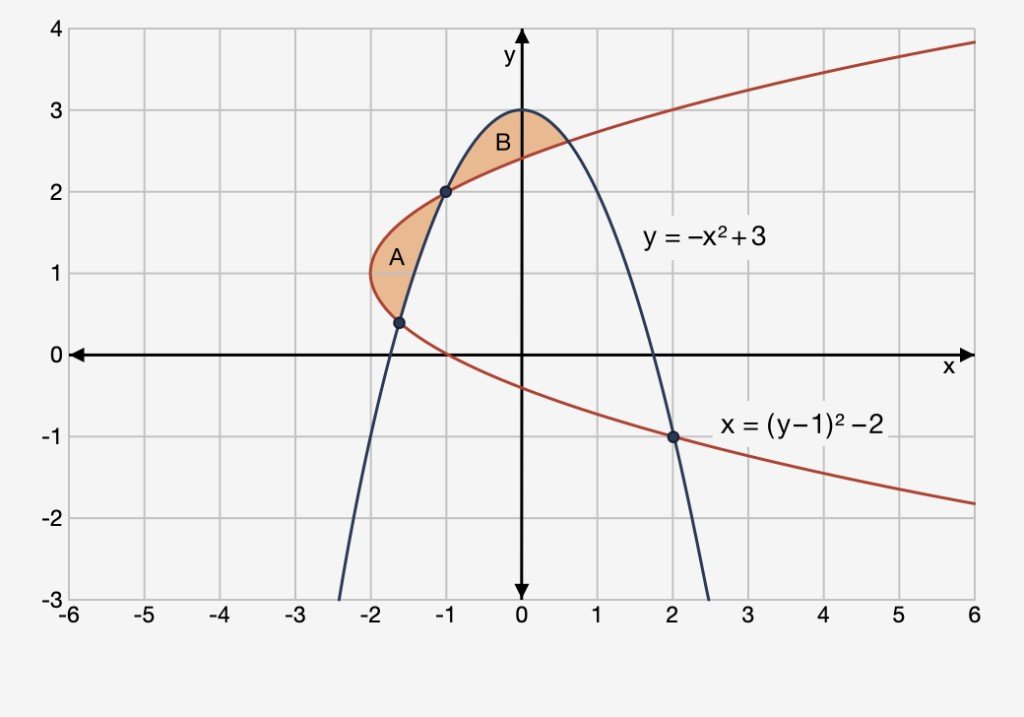
For the regions A and B shown in the graph:
Part A: Discuss the limits of integration. (3 points)
Part B: Set up an integral expression that represents the total area. (4 points)
Part C: Calculate the total area. (3 points)
 Nicolas Santana
300
![Matchmaticians Applications of Integration [Calculus 1 and 2] File #1](https://matchmaticians.com/storage/question/103528/matchmaticians-ivbm53-file-1.png)
Answer
Answers can only be viewed under the following conditions:
- The questioner was satisfied with and accepted the answer, or
- The answer was evaluated as being 100% correct by the judge.
1 Attachment
 Kav10
Kav10
2.1K
-
What are the Limits of integration? So Interval Notation?
-
The limits of integration are written in the seventh line. 2 and (3-sqrt(5))/2.
-
Does that make sense?
-
-
But they should be this intervals of region A and B so: Region A: From -2 to -1 Region B: From -1 to 0.6 (which is the square root used)
-
No, when integral is dy, the interval should be from y axis, when it is dx, the interval should be from x axis. See the solution where it uses the y limits for the integral …dy and x limits for integral …dx. Does that make sense now?
-
-
Yes, so you used Horizontal slices
-
Both. Yes.
-

The answer is accepted.
Join Matchmaticians Affiliate Marketing
Program to earn up to a 50% commission on every question that your affiliated users ask or answer.
- answered
- 2038 views
- $12.00
Related Questions
- What is this question asking and how do you solve it?
- Find $n$ such that $\lim _{x \rightarrow \infty} \frac{1}{x} \ln (\frac{e^{x}+e^{2x}+\dots e^{nx}}{n})=9$
- Use Stokes’ Theorem to calculate $\iint_{S} \nabla \times V· dS$ on the given paraboloid
- Calculus - stationary points, Taylor's series, double integrals..
- Derivative question
- Custom Solutions to Stewart Calculus, Integral
- Compute $\lim_{x \rightarrow 0} \frac{1-\arctan (\sin(x)+1)}{e^{x}-1}$
- Basic calc question